The lab, 06
The fingerpost F
Find a Drive needed a mark you'd know at a glance and could draw from memory. It took four rounds in three days: folded maps, road signs and contours, a hundred and two silhouettes drawn to a brief built on research, and one finalist drawn properly. It's a fingerpost, the sign that shows you the way on a British road, and its post and arms make an F.
- Made for
- Find a Drive, our app for finding and planning great drives
- When
- 24 to 27 October 2026
- Made with
- Research, a hundred and two silhouettes, and Blender for the 3D
The fingerpost F

Four rounds
The first round folded maps: a map folded the surveyor's way, a route cut from paper, and an open sheet with a road across it. We chose the open sheet, refined it and drew it up properly, then dropped it the next day: it was a scene rather than a sign, and took too long to read.
The second round went after a sign rather than a scene: a disc split between paper and ink, with two summits and the road over the pass between them, and four more. We dropped all five. None had a shape of its own, or anything you'd recognise at a glance.
A brief built on research
Before round three we read what's known about how marks are recognised. The finding that mattered: design explains a good deal of whether a new mark is liked, and very little of whether it's recognised. Recognition is learned, so a new mark should be one real thing you can name, known from its outline. The brief that came out of it:
- One figure
- One closed, solid figure, recognisable from its outline alone.
- From memory
- Something you could draw after seeing it once.
- Small
- Still recognisable at 16 pixels, the size of a browser tab's icon.
- One colour
- Dark on light, and light on dark.
- Made
- Flat enough to cut in vinyl for a car's window, and to stitch in thread on a cap.
- Moving
- Able to move: one day, to swing its arms and point the way.
A hundred and two silhouettes
Round three put shape first: a hundred and two black silhouettes in twelve families, each drawn at 16 pixels as well. Fourteen went through tests we could run ourselves: dark on light and light on dark, at 32 and 16 pixels, blurred, turned, upside down and mirrored, and as an app's icon.
Why the fingerpost
We chose the fingerpost, standing upright, on the day of the tests, for plain reasons:
- You pass fingerposts whenever you're exploring.
- They're how you find the way you want to go, which is what Find a Drive is for.
- They tell you where to drive.
- And a fingerpost's post and arms make an F.
It's one real thing you can name, from the British roads Find a Drive is about, and it's a letter as well as a figure, which holds up at 16 pixels.
Drawn by numbers
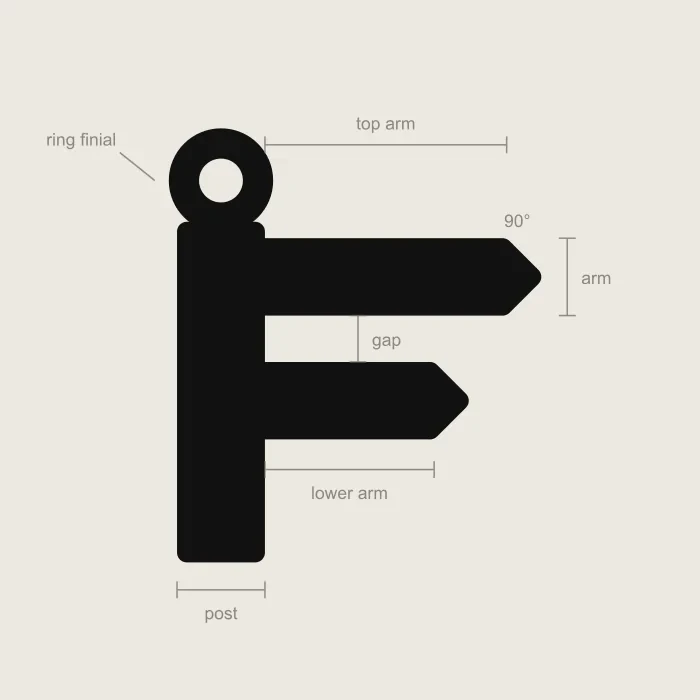
- Eighteen settings
- The F is built from its parts, the post, the arms, their pointed ends and the ring on top, by eighteen numbers fitted to a square, so any of them can be changed and the rest follow.
- Arms lighter than the post
- Horizontals look heavier than uprights, so the arms are drawn a little thinner.
- Centred by eye
- It's set a third of the way from the middle of its outline towards the middle of its weight, so the pointed arms don't leave the right of the square looking empty.
- A size for every size
- At 24 pixels and under, the ring closes to a ball and the arms thicken. At 16 and 32 pixels, every pixel is placed by hand.
Twelve styles
Then we tried the F in twelve styles, from flat to chrome to a snowy winter's day. Flat became the mark, and letterpress its softer twin, which is also the app's icon on a phone's home screen.
One style, drawn like an engineering drawing, suited us, the company behind Find a Drive, better than it suited Find a Drive. So we kept it for ourselves: it's how our own mark, the D and the I is drawn.
More from the lab
Everything in the lab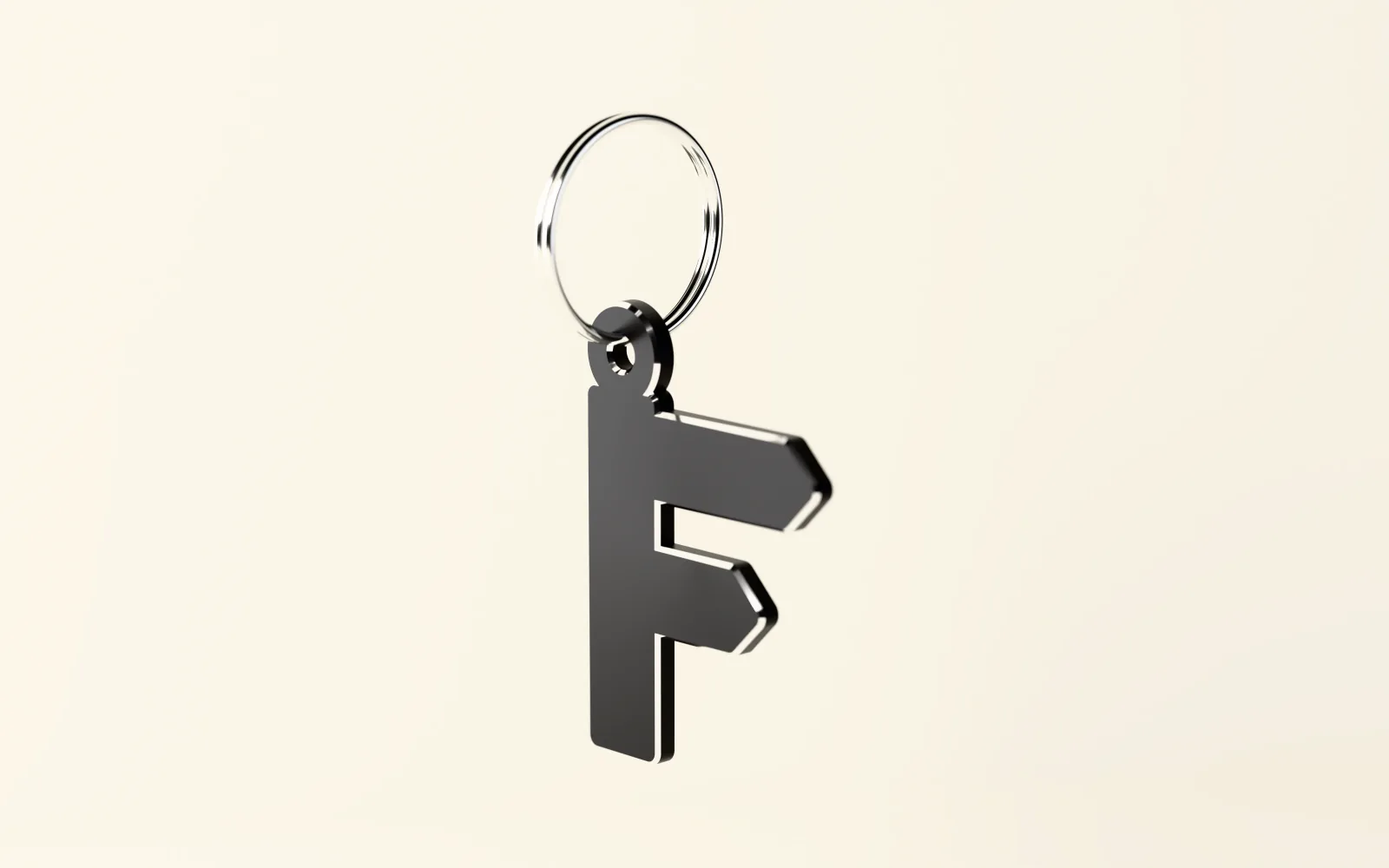
07, for Find a Drive
The keyring
Find a Drive's mark, the fingerpost F, as a 50mm keyring tag in black anodised aluminium with diamond-cut edges: a 3D render, made to see whether the mark works as a real object.
Read it
01, for ourselves
The D and the I
Our mark: what it hides, how it's built on a square, and the same object in chrome and anodised aluminium.
Read it


Contact
Talk through your project.
Tell us what you'd like to build, or what's getting in the way. A few lines is plenty to start with, and the first conversation is free.