The lab, 01
The D and the I
Our mark is an I and the bowl of a D, cut apart, that read together as one D. It began as a sketch by Harry Phillips, who founded the company, and was drawn up as an engineering drawing: every measurement a whole number, taken from one fixed point, the datum. It hides more than it shows.
- Made for
- Driven Innovations
- Drawn
- October 2026, as drawing DI-001
- Made with
- Our own drawing tools, Blender for the pictures, and three.js for the 3D in your browser
Four ways to read it
Look again, and it says rather more than our initials.
01, DI
Driven Innovations
Our initials, as one letter: an I and the bowl of a D, cut apart, that read together as a D.
02, ID
IDRead from left to right, it's ID: what a database gives every record, so it's never mistaken for another. Most of what we build has one underneath.
03, Ideas
eas,engineered.
And ID is how Ideas begins: ideas, engineered, which is what we do.
04, Code
engineer(ideas[yours
To anyone who writes code, the I is a closing square bracket and the D a closing round one: the end of a line that's finished.
Built on a square
Everything's measured from the datum, the red square at the I's top left. The mark is exactly 100 units square, and every measurement is a whole number of them.
- The bowl
- A semicircle of radius 50, centred on the square
- The counter, the hole in the D
- A semicircle of radius 30, its centre 4 to the left, so the bowl swells from 20 at its arms to 24 at its widest
- The I
- An upright of 22, its serifs reaching 15 to the left and 20 deep
- Where serif meets upright
- A curve of radius 6, as a cutting tool leaves on a machined part
- The cut
- 6 between the I and the D, opening to 7.5, 9 and 11 as the mark gets small, so it never closes up
- The corners
- Rounded to a radius of 3, every outside corner
Made in metal
The same mark, modelled in 3D as a machined part: polished chrome in dark mode, and black anodised aluminium with diamond-cut edges in light mode. It's the mark that turns behind “Talk through your project.” at the foot of every page. Here, it's yours to handle: drag it, or use the arrow keys, to turn it.
- One 3D model
- Its parts are modelled once, from the drawing's own outline, with every edge bevelled slightly, as a machinist would leave it. The same model goes to Blender for the still pictures, and to your browser for the one above.
- One studio
- Both are lit by the same studio, a virtual one, set down as numbers: a sky that brightens towards the top over a black floor, a soft horizon, and softboxes and strip lights round about.
- Softened edges
- The studio is an image wrapped round the mark, and a mirror magnifies its surroundings so much that hard-edged lights showed the image's pixels as steps. A real softbox's edges are soft, so ours are too.
- True colour
- Both turn computed light into a screen's colours the same way, with a standard made to keep products true to colour (Khronos PBR Neutral), so the chrome stays neutral and the anodising stays black rather than turning blue.
- No permission prompts
- At the foot of each page, it leans as you tilt your phone, on phones that share their tilt without asking. An iPhone would ask your permission first, so on an iPhone it stays put rather than interrupt you.
- Or holds still
- If your device asks for less motion, it holds still. In a browser that can't draw 3D, a picture rendered in Blender takes its place.
Small, and sharp
In a browser's tab, the mark sits on a tile that's the opposite of your browser's light or dark mode, so it stands out. At 32 and 16 pixels, every pixel is placed by hand, so its straight edges stay crisp and only the bowl's curve is softened.
 32px, light mode
 32px, dark mode
 16px, light mode
 16px, dark mode
The drawing
The mark's master drawing, DI-001, follows BS 8888, the British Standard for engineering drawings: the plan above the front view, the side view to its right, and every measurement taken from the datum. Its exploded view, the parts drawn slid apart, was traced by Blender from the 3D model, so even the edges you can't see, drawn dashed, are where they really are. Engineering drawings warn you not to measure off the paper; the note on ours reads: Do not scale. Ask us.
More from the lab
Everything in the lab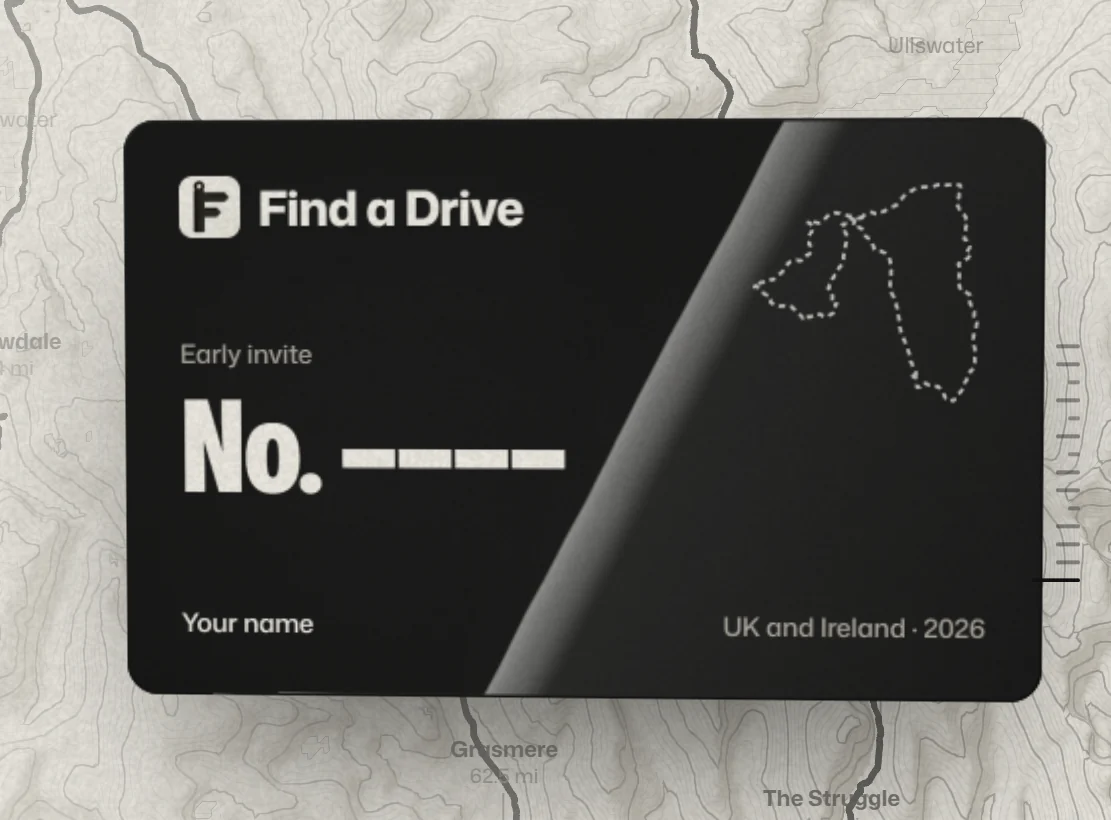
02, for Find a Drive
The member card
Find a Drive's membership card, in a colour each member chooses, lit like real car paint by a graphics program of our own: gloss, metallic, pearlescent, chrome and matte.
Read it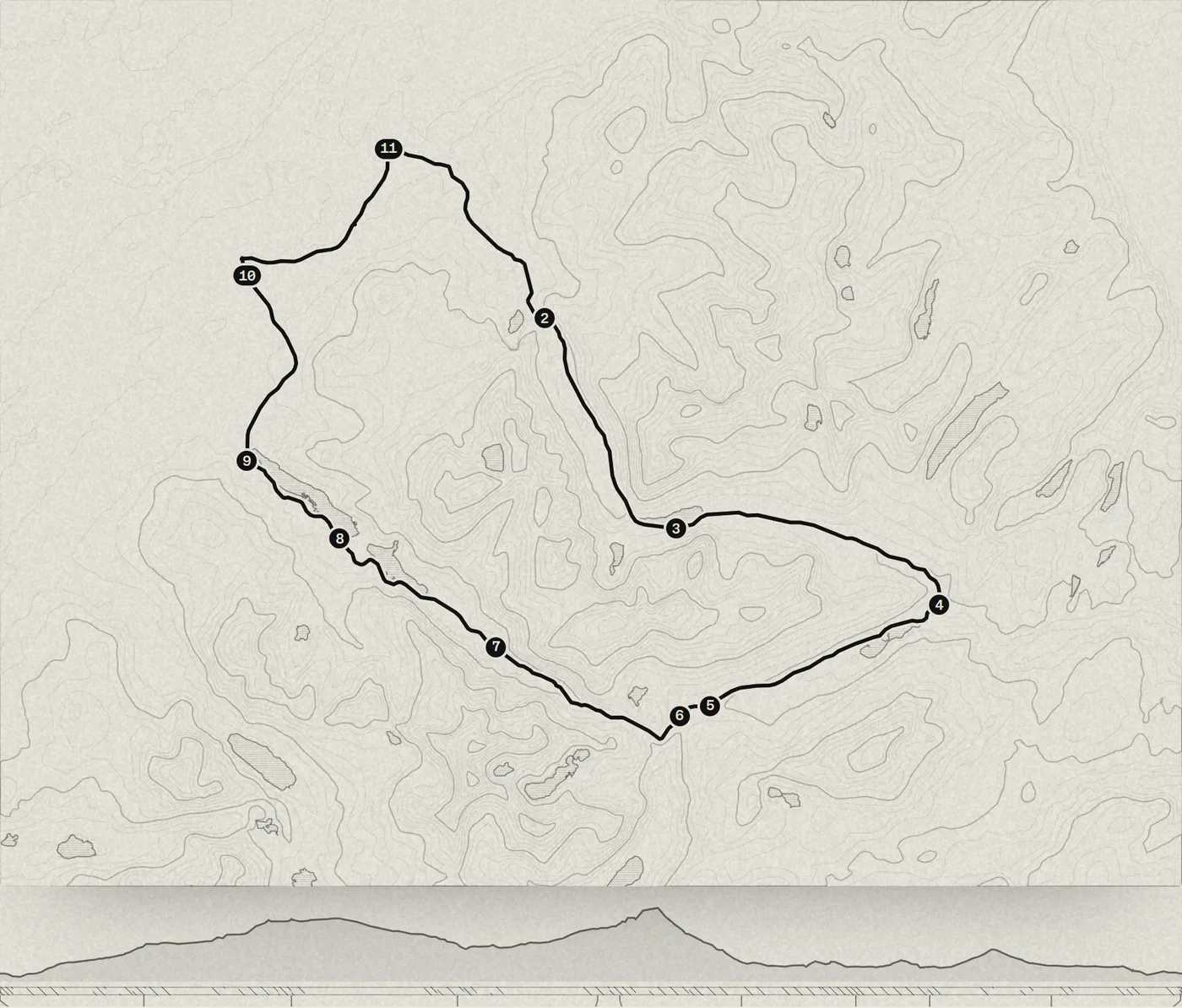
03, for Find a Drive
The drive viewer
How Find a Drive draws every route on a contour map of the land it crosses, plays it out stop by stop, then opens it in 3D to look round the hills or fly the road.
Read it


Contact
Talk through your project.
Tell us what you'd like to build, or what's getting in the way. A few lines is plenty to start with, and the first conversation is free.